
Criminal Cases in Putnam County Courts
Putnam County divides criminal work by jurisdiction. Superior Court is the general-jurisdiction trial court for felonies. State Court hears misdemeanors and traffic prosecutions. Magistrate Court handles warrants, first appearances, and preliminary matters, while Eatonton Municipal Court keeps its own city ordinance and municipal traffic files. Juvenile Court records follow separate confidentiality rules and should not be treated like public adult dockets.
The Clerk of Superior, State, and Juvenile Courts is the custodian for filed Putnam County cases in those courts. Its record starts with an accusation or indictment and follows the prosecution through motions, hearings, plea or trial, judgment, and sentence. A sheriff report is different. It describes an incident or arrest, while the clerk's file shows what prosecutors filed and what the court ultimately did. Searchers who need the legal outcome should use the court record, not infer it from a booking entry.
Putnam Criminal Courts Compared
The charge level points to the likely Putnam County court, though the filed charging paper is the best proof. The clerk serves both Superior and State Courts, so one office can help distinguish the divisions. Municipal and magistrate files remain distinct.
| Court | Criminal role | Best record clue |
|---|---|---|
| Superior Court | Felony prosecutions | Indictment or felony accusation, docket, judgment, and sentence |
| State Court | Misdemeanors and traffic | Accusation, plea or trial entry, and disposition |
| Magistrate Court | Warrants and preliminary proceedings | Warrant, first-appearance, or preliminary-matter entry |
| Eatonton Municipal Court | City ordinance and municipal traffic matters | City citation and municipal disposition |
How to Search Putnam County Case Records
Begin at the Putnam clerk's Search page. It links to Case Search, but the target entered a redirect loop when checked in July 2026. Do not treat a failed page or an empty result as proof that no Putnam County criminal case exists. Exact case numbers are the strongest key. A party name can work when the vendor is available, but names should be checked against other public identifiers to avoid confusing two people.
- Open the clerk's Search page and choose Case Search.
- Select the criminal court or category if the linked provider asks.
- Enter the exact case number when known, or search by party name.
- Open the docket and read the result for each separate count.
- Ask the clerk for a plain or certified copy when the online view is incomplete.
The linked vendor's live controls were not verified, so the table separates confirmed search keys from fields that must be checked on the current screen. Georgia Courts E-Access is also a routing service for participating courts, not one free statewide trial-court database.
| Field Label | Type | Required | Notes |
|---|---|---|---|
| Case number | Text | No single field confirmed | Preferred exact key when available |
| Party name | Text | No single field confirmed | Compare identifiers before relying on a match |
| Criminal court/category | Selection if offered | Provider dependent | Use Superior for felonies and State for misdemeanors or traffic |
| Filing year | Filter if offered | Provider dependent | Useful for narrowing a common name |
| Date of birth | Filter if offered | Provider dependent | Do not assume it appears publicly |
When Putnam Case Search Fails
A missing electronic result has several possible causes. An older Putnam County file may be archived, a name may be indexed differently, or access may be limited by sealing or juvenile confidentiality. A new arrest may also lack a court case number until the prosecutor files the charge. Write down the name, likely court, approximate filing year, and any case or citation number before contacting the clerk.
The verified fallback is direct: email info@putnamcourtclerk.org, call 706-485-4501, or visit the clerk at 100 South Jefferson Avenue, Suite 236, Eatonton. The counter is open Monday through Friday, 9:00 a.m. to 5:00 p.m. Ask whether the matter is older, archived, held in another court, or unavailable to the public. The clerk also advertises online certified copies and a First Offender case/document request, but current eligibility and fees should be confirmed before ordering.
The official Putnam County clerk homepage shows the local office that maintains these records.
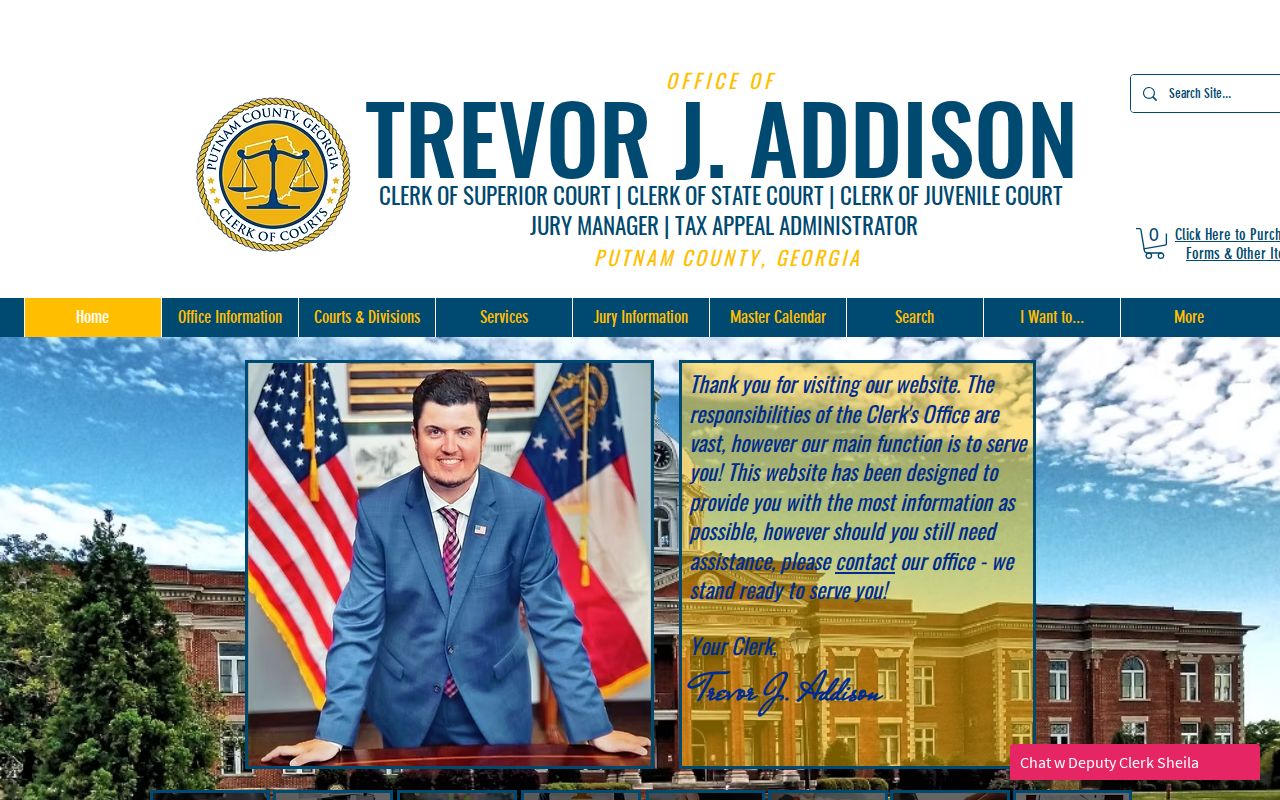
That office remains the authoritative route when a remote index gives no usable result.
What the Putnam Case File Shows
A Putnam County case file identifies the court, case number, filing date, case type, status, and assigned judge. It can show the State of Georgia and the defendant, public attorney information, the charge text and statute, count number, offense date, and felony or misdemeanor class. Docket events may include an accusation or indictment, arraignment, motions, hearings, plea, verdict, judgment, sentence, probation, and warrant or capias entries. A capias is court process directing that a person be taken into custody.
| Case Number & Court | The unique file key and the Putnam County division holding it |
|---|---|
| Charging Document | Accusation or indictment listing filed counts and alleged statutes |
| Docket Entries | Chronological filings, motions, hearings, pleas, and court orders |
| Hearing Dates | Scheduled or completed proceedings, subject to confirmation with the clerk |
| Disposition & Judgment | The result of each count, such as conviction, dismissal, acquittal, or nolle prosequi |
| Sentence & Conditions | Custody, probation, fines, costs, restitution, and public conditions when docketed |
Bond type and later changes may appear, as may fines, statutory surcharges, costs, and public restitution entries. Not every docket line includes a free document image. Social Security numbers and other protected identifiers are redacted, and sealed, juvenile, victim, or protected material may not be visible.
Read Putnam Criminal Counts Separately
A case-level status does not always state the outcome of every charge. One Putnam County count may end in a guilty plea while another is dismissed or placed on the dead docket. Read each count, its docket entries, and its disposition. “Nolle prosequi” means the prosecutor formally chose not to continue that charge. An acquittal is a not-guilty decision. Neither term means the same thing as a conviction.
Calendar abbreviations can add another trap. The 2026 Ocmulgee Judicial Circuit calendar uses CR for criminal trials, MD for motion day, SC for status conference, NJ for non-jury, and PD for plea day. Those labels describe calendar settings, not outcomes. ATCC refers to Adult Treatment Court Collaborative and PAC to Parental Accountability Court. Verify any hearing date with the clerk because a calendar code alone does not prove that a hearing occurred or how it ended.
The Judicial Council of Georgia provides the statewide court context shown here.
Georgia's court structure explains why a Putnam County search must start with the correct local division.
Stages of a Putnam County Criminal Case
The public court file begins to take shape when a prosecutor files charges. An accusation is a prosecutor's charging instrument used where Georgia procedure permits it. An indictment is a grand jury's formal felony charging instrument. Arraignment is the stage at which the accused is called on to answer the filed charge. Pretrial work can include motions, discovery disputes, bond issues, and scheduled conferences.
Case flow: Charges Filed › Arraignment › Pretrial › Plea or Trial › Disposition › Sentencing
A plea or trial produces a result for each count, followed by judgment and sentencing when there is a conviction. Timing varies with the case and calendar, so no fixed Putnam County duration should be assumed. A booking can predate the filed case, and later reporting can lag. That is why an arrest record may appear before a case number and why a GCIC history may not yet show the court's final result.
Putnam Court Access Beyond the Gateway
Georgia Courts lists PeachCourt mandatory electronic filing for Putnam Superior and State Courts. E-filing is not the same product as a full free public docket. The distinction mattered during the January 2025 winter-weather judicial emergency, when Putnam courts closed their buildings but remote filing remained available. That event shows why digital court operations may continue even when a counter closes.
It does not prove that every filing is open online or that a scheduled hearing will occur. Confirm a current closure order, hearing date, and document access with the clerk. For a public record request, describe the specific case, document, date range, and preferred format. Ask whether a copy is certified and whether a fee estimate applies. The official research did not establish a current comprehensive clerk fee schedule, so no per-page or certification price should be assumed.
The clerk's online search options show the Case Search entry and the digital starting point.
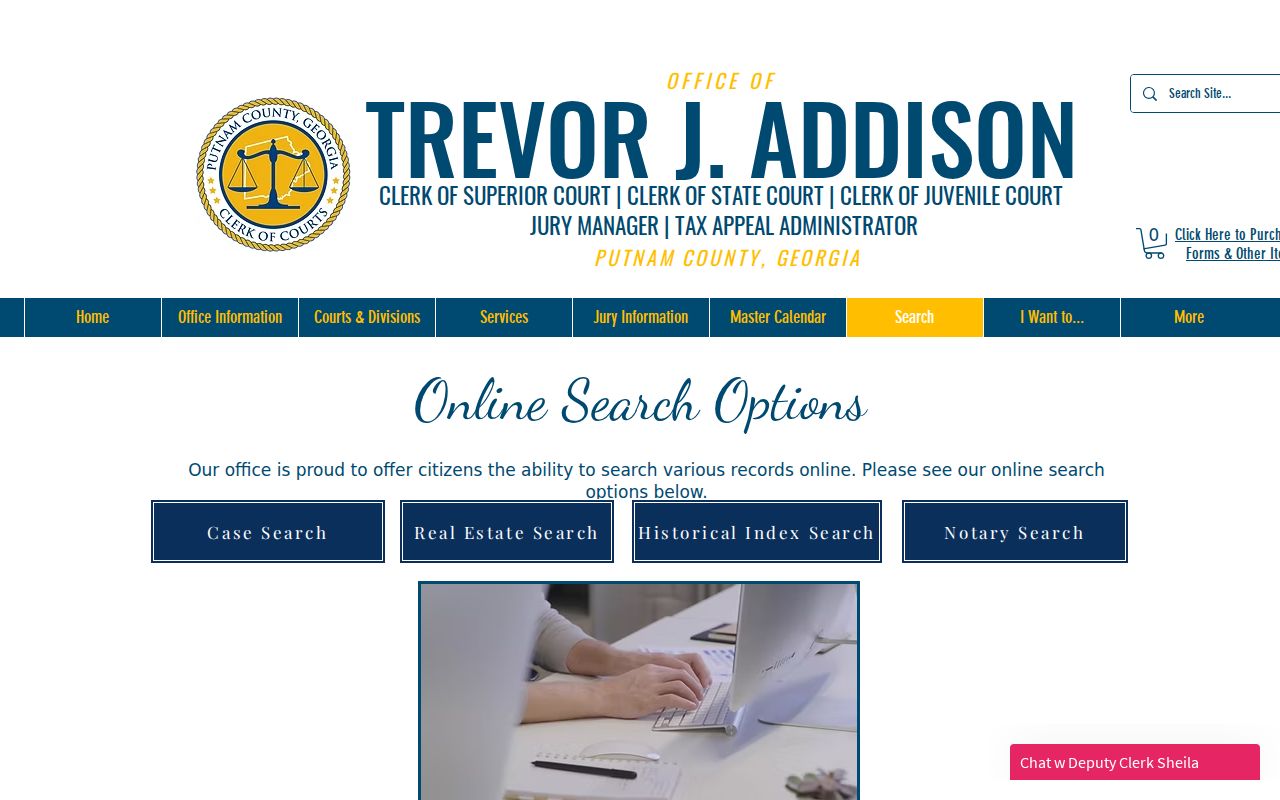
The screenshot also reinforces the need to keep the clerk's direct contact route ready when the linked provider fails.
Putnam Case Record Access and Restrictions
The Georgia Open Records Act, O.C.G.A. §§ 50-18-70 through 50-18-77, favors access but does not make every page public. Court custodians can redact protected identifiers and withhold material covered by law. Juvenile files fall under O.C.G.A. § 15-11-700 and related provisions and should not be expected to behave like adult Putnam County criminal dockets. Victim information, sealed material, and other protected content may also be limited.
Record restriction under O.C.G.A. § 35-3-37 concerns eligible GCIC arrest information, while court sealing is a separate access issue under the statute. Neither should be mistaken for deleting all government records. If an adult case does not appear, ask the clerk whether it is archived, differently indexed, or legally unavailable. Request nonexempt portions and a statutory basis for any withholding.
Putnam Court Files Versus GCIC
A GCIC history and a Putnam County case file answer different questions. GCIC links reported arrest cycles to dispositions supplied by courts, prosecutors, and other justice agencies. The clerk's file is the direct record of the prosecution. It holds the charging paper, docket activity, court orders, count-level outcome, and sentence. A person reviewing an apparent error should compare both rather than expect one product to reproduce the other.
If the court file shows a final result that never reached GCIC, first obtain documentation from the originating Putnam County court. GBI explains that a correction needs authority or documentation from the agency that owns the event, and it routes missing disposition issues through the court. Identify the arrest and case as precisely as possible. The broader Putnam County criminal history overview explains how the local file feeds the state system.